Hoping to keep a running A.B. for reads in 2026 to help log shorter pieces/articles/excerpts/everything I don’t finish (I tend to lose track of a lot of that stuff unless I end up working it into an article). Can’t say a thing about how likely I am to stick to it for the year but it seems like it’ll be a fun side project. Comments/annotations will probably be spotty/inconsistent — I’ll probably have more to say here about books that are either shorter, newer, or less widely read (where there’s actually new stuff to say). Hoping to include thoughts/responses/comments on/to present day articles going forward as well. We’ll see!
Here’s a test run for the month of December:
Books (Completed)
Thanks for reading ⚚ 𝓦 𝓨 𝓓 𝓘 𝓦 𝓨 𝓓 ⚚! Subscribe for free to receive new posts and support my work.
Reed was a longtime blindspot until this past fall -- I’d read Mumbo Jumbo years ago, liked it, but never pursued anything else; spent quite a bit of time with his more recent work while working on my Late-Style piece for LARB and really can’t believe it took me as long to get to his work as it did -- Conjugating Hindi (2018) and Juice! (2011) are high on my list of favorite things I read in 2025; Reckless Eyeballing, which follows the development and staging of a play by Ian Ball, a black playwright who recently moved from the Caribbean to New York; Ball’s play, which stages exhumation and re-trial of a black teenager who was lynched for staring at a white woman, sees its debut on the same night as a controversial play by Ball’s friend, Tremonisha Smart, that offers a controversial feminist rehabilitation of Eva Braun; writing from 2000, Reed was weirdly prescient in his anticipation of the difficulties that come with navigating and triangulating between minority movements during the peak-cancel-culture media/representational politics of the 2010’s/early 2020’s; sharp satire/pretty compelling teardown conservative caricatures of racial and feminist politics (though not quite as developed as his treatment of the same issues in Conjugating Hindi) + the strong presence of 90’s-era discourse and debate over multiculturalism makes the book an interesting time capsule to show how the conversation has changed/developed
Szabo, Magda. The Door. 1987. Trans: Rix, Len. New York: New York Review Books, 2015.
Neat little slice-of-life look at inter-class relationships and the working life of intellectuals in mid-Century, communist-era Hungary; a little out of my wheelhouse but really enjoyed this book + would love to check out my Szabo soon
Warner, Sylvia Townsend. After the Death of Don Juan. 1938. London: Penguin Modern Classics, 2021.
Fun tragicomic riff on Don Juan myth set in 17C Spain; similar (but less claustrophic and cloistered) strain of Warner’s play w/ spread rumor to what she was playing with in The Corner that Held Them; p. cool injection of class commitment and gossip in how she handles where aristocratic/peasant class characters take sides as rumor spreads; reviews comment on allegorical parallels to Spanish Civil War + this kinda pulled back the curtain on how big of a historical blind spot this is -- whatever connection there is between the book and the war went over my head
Series of articles, essays, and letters between early- and mid-20th century Marxist literary critics debating what Fredric Jameson calls the “Realism-Modernism Dialectic” in his afterward to the book. Essentially a speed run through the German side of Jameson’s Marxism and Form. Very, very well curated and edited by Anderson, Livingstone, and Mulhern (w/ excellent intros to each paired set of writings). Essentially a speed run through Lukacs and Bloch dispute expressionism and fragmentation: Bloch favors fragmentation as proper way to represent our fractured experience of totality where Lukacs claims that this only further reproduces and continues fragmentation; Benjamin and Brecht take stock of the Lukacs/Brecht feud, claiming that the “realism” that Lukacs favors does not reflect his philosophical stance on reality: he falls back on calling for fidelity to drawing from the raw material of empirical detail, despite his Hegelian position that “reality” is not to be found in immediate experience but in the mediated synthesis of the objective and subjective; Brecht (in large part) agrees with Lukacs on the nature of reality, but argues that this opens space for modernist experimentation to effectively work as realism-by-other-means; Adorno and Benjamin critique and work through Benjamin’s Arcades Project, which Adorno hopes to purge of WB’s occasional drifts into superstition and tendency to replace class consciousness w/ something approaching Jungian collective consciousness (a lot of this was lost on me -- I don’t know Benjamin’s work well enough); Adorno feeds Lukacs into the woodchipper in the final presentation of essays: takes him to task for becoming a mouthpiece for the Party after his move to the USSR, makes a similar argument to Brecht, but bolsters it a great deal by coming at it from the position of a philosopher and critic, rather than as a practicing artist; Fredric Jameson takes stock of the debate and tallies up the score in the book’s afterward: agrees, on the whole, with Lukacs about what art should set forth to do, but accepts critiques levelled by Adorno et. Al about how art should proceed -- the experimental methods pioneered in the modernist period, as a means were valuable gains, but they must not be taken as ends; concludes by suggesting a synthesis of Lukacs’s and Brecht-Adorno’s positions:
“Under these circumstances, the function of a new realism would be clear; to resist the power of reification in consumer society and to reinvent that category of totality which, systematically undermined by existential fragmentation on all level sof life and social organization today, can alone project structural realitions between classes as well as class struggles in other countries, in what has increasingly become a world system” (236)
Agamben, Giorgio. The Body of Language: esperruquancluzelubelouzerirelu. 2025. Trans: Attell, Kevin. Naveen Kishore: Seagull Books, 2025.
Short ‘n’ sweet Agamben on art & language -- the good stuff + what I wish got more attention than his political commentary; very, very insightful commentary on grammar as the material body of language that helps meaning take shape; banger of a chapter on bein’ a silly li’l guy in Erasmus and Rabelais; fun illustrations (woodcut reproductions? need to track these down); Agamben (unfortch) joins the countless ranks of weak/thin readers of Mikhail Bakhtin -- likely (as usual) from reading RAHW w/o a closer eye to MB’s early work on language
Anders, Gunther. The Obsolescence of the Human. 1956. Ed: Muller, Christopher John & Dries, Christian. Trans: Muller, Christopher John. Minneapolis: University of Minnesota Press, 2025.
Lengthier review forthcoming -- this was a winner; Anders’s concept of “promethean shame,” which leaves us with a sense of guilt/shame/humiliation when confronted by technology that can do everythinwe can (+ often does it better) was tough to believe came from the 1950’s; rip into arms race/nuclear weapons was of a piece with Michel Serres’s Hermes III essay on betrayal.
Jameson, Fredric. Marxism and Form: 20th-Century Dialectical Theories of Literature. Princeton: Princeton University Press, 1971.
Excellent intro to nuts and bolts of Adorno, Benjamin, Marcuse, Bloch, Lukacs, and Sartre’s programs for the application of dialectical thought to art (more broadly) and literature (specifically). Compelling synthesis of the thinkers’ ideas into a coherent, legible, and repeatable literary critical methodology. Planning to go straight to Jameson’s sources for this book in the next few months…this has already proven to be a valuable resource and companion to Lukacs’s History and Class Consciousness and the exploratory toe-dipping I’ve done with Sartre recently; will likely be revisiting for the foreseeable future.
Lukacs, Georg. History and Class Consciousness: Studies in Marxist Dialectics. 1922. Trans: Livingstone, Rodney. Boston: MIT University Press, 1972.
Picked up for the reification essay, stuck around for the piece on orthodox Marxism; will be revisiting @ length; much, much stronger work than Theory of the Novel, which GL seemed to be pretty embarrassed by throughout H&CC; consistent and thorough thumping of both horizontalist syndicalism as well as early 20th c. Social Democrats; went a long way toward clarifying and illustrating some of Fred Jameson’s very basic assumptions about art’s relationship to totality
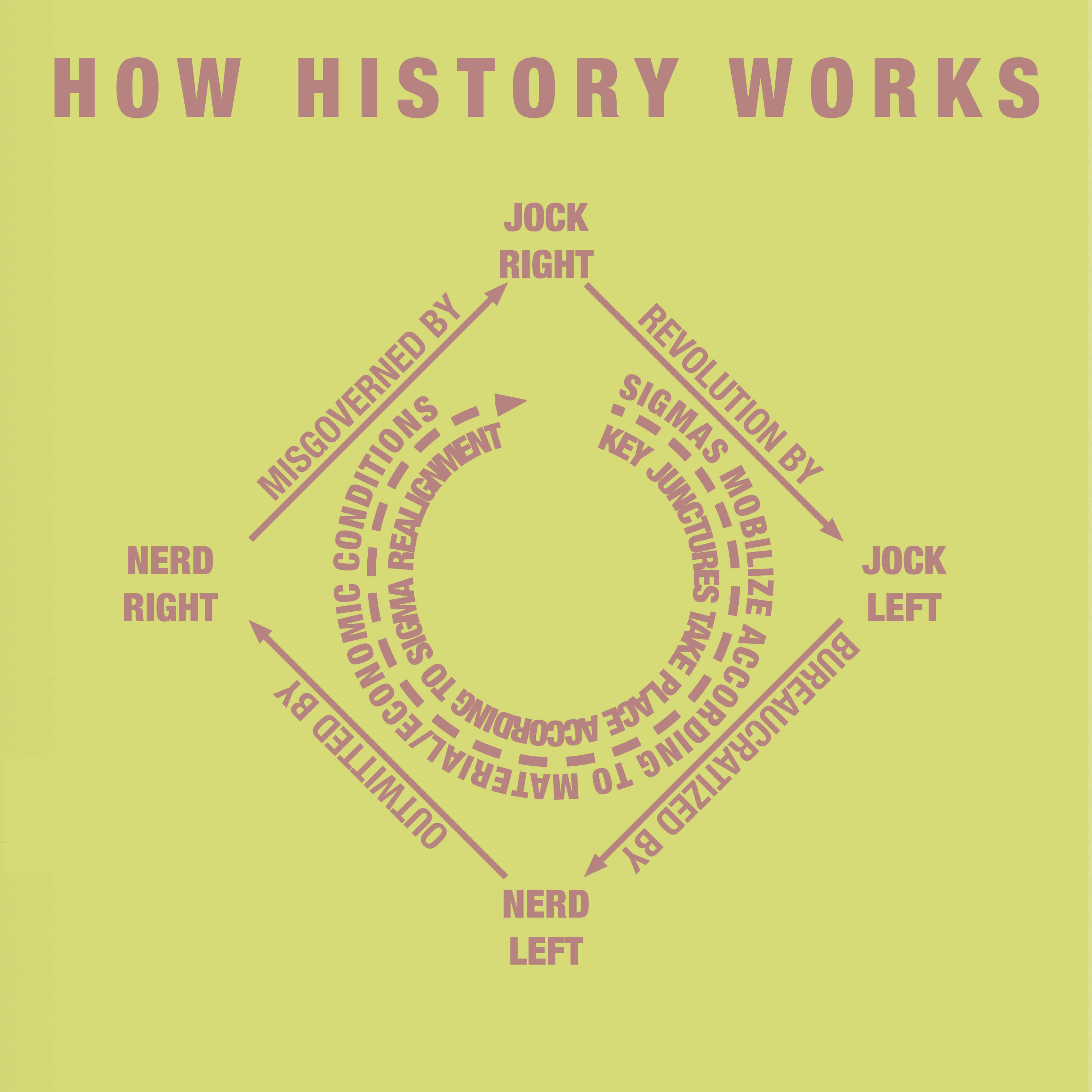
(I made this as half-jokingly a few months ago — it doesn’t seem too far off from G.L’s view of how the dialectic takes shape in history):
Marcuse, Herbert. Eros and Civilization: A Philosophical Inquiry into Freud. Boston: Beacon Press, 1955.
Marcuse puts forth something that looks like a revised version of Charles Fourier’s vision of utopia by offering correctives from Freud and Marx; reassessment of the relationship between Freud’s pleasure and reality principles; argues for a far more flexibility in the reality principle, which Marcuse argues is not a natural given but instead, historically and socially determined; reality principle is tied to scarcity, powers that be continue to reproduce existing conditions of scarcity, eventually fold this over into domination of oppressed classes; expanded capacity for production reduces scarcity, which Marcuse claims should help us live under a less harsh reality principle -- ruling classes capitalize on holdover reality principle that assumes a greater degree of scarcity to shore up privilege; deeply challengingresponse to early champions of sexual liberation/free love (such as Erich Fromm & Norman O. Brown)
Slobidian, Quinn. Hayek’s Bastards: Race, Gold, IQ, and the Capitalism of the Far Right. New York, Zone Books: 2025.
Speed run tracing the lineage of contemporary national conservatism and the alt-Right to the same point of origin as the neoliberalism that figures like Yarvin, Vance, and Musk claim to resist; serious bonus points to Slobidian for giving a clear and distinct contours to his working definition of neoliberalism instead of the sloppy treatment the term often gets from podcasters/pundits/politicians that take it to mean whatever they don’t like about the 21st century economy and the culture it fostered; argues that tthinkers of the post-Hayek capitalist right from Murray Rothbard to Charles Murray to Lew Rockwell to Richard Spencer all reach their conclusions about biological determinism, race, and IQ by misreading Hayek, the seeds of their misreadings were latent in Hayek’s own work from the outset; includes in-depth looks at the development of think-tank-neoliberalism’s right-wing on issues of individualism/collectivism, borders and immigration, race science, and an especially harrowing spin through the gold standard hardliners’ apocalypticism; weirdly, I actually recognized a lot of the territory that QS covers from Dan Friesen and Jordan Holmes’s (very good!) ten hour review of Alex Jones’s 2008 documentary (?), End Game, on Knowledge Fight; though Slobidian does a great job explaining how Hayek’s thought helped make the present-day far-right possible, I do wish he’d spent more time on the topic of religion -- though I’ve always associated capital-L Libertarianism w/ Penn Jillette-style libertine atheism, Slobidian does a very, very good job underlining how social conservatism is equally compatible with free-market fundamentalism…many of the figures he includes in the piece are high-profile evangelicals, however, where he covers the link between libertarianism and culture conservatism, he tends to filter it through its more secular representatives….there’s likely a full chapter to be written explaining why the post-Hayek right-wing seems so appealing to conservative Christians in general and Evangelicals in particular
Book Chapters/Essays:
Jameson, Fredric. “Pleasure: A Political Issue.” 1983. The Ideologies of Theory: Essays 1971-1986, Volue 2: The Syntax of History. Minneapolis: University of Minnesota Press, 1988. 61-74
Jay, Martin. “The Noblest of the Senses: Vision from Plato to Descartes.” Downcast Eyes: The Denigration of Vision in Twentieth-Century French Thought. Berkley: University of California Press, 1993.
Jay, Martin. “Dialectic of EnLIGHTenment.” Downcast Eyes: The Denigration of Vision in Twentieth-Century French Thought. Berkley: University of California Press, 1993.
Jay, Martin. “The Crisis of the Ancien Scopic Regime: From the Impressionists to Bergson.” Downcast Eyes: The Denigration of Vision in Twentieth-Century French Thought. Berkley: University of California Press, 1993.
Wegner, Philip. “Conditions of Utopia in 2312.” Invoking Hope: Theory and Utopia in Dark Times. Minneapolis: University of Minnesota Press, 2020. 187-206.
Wegner, Philip. “Introduction: Reading in Dark Times.” Invoking Hope: Theory and Utopia in Dark Times. Minneapolis: University of Minnesota Press, 2020. 1-28
Wegner, Philip. “Politics, Art, and Uotopia in ‘Babette’s Feast.’” Invoking Hope: Theory and Utopia in Dark Times. Minneapolis: University of Minnesota Press, 2020. 145-168.
Wegner, Philip. “Reading the Event of the New Criticism and the Fate of the Republic.” Invoking Hope: Theory and Utopia in Dark Times. Minneapolis: University of Minnesota Press, 2020. 31-67
Wegner, Philip. “Toward Non-reading Utopia.” Invoking Hope: Theory and Utopia in Dark Times. Minneapolis: University of Minnesota Press, 2020. 69-96.
Books (In Progress):
Flusser, Vilem. Thinking Further: Fragments of Communicology. Ed.: Jaffe, Aaron, Miller, Michael F., Wagnermaier, Silvia, & Zielinski, Siegfried. Trans.: Battaglia, Andrew & Raschke, David. Minneapolis: University of Minnesota Press, 2025.
Sartre, Jean-Paul. Being and Nothingness. 1943. Trans.: Richmond, Sarah. New York: Washington Square Press, 2021. 1-50.
Everything Else
Articles (Scholarly):
Bewes, Timothy. “Form-Problems in Fredric Jameson.” Cultural Critique Online. Issue 128, Frame 13.
Da, Nan Z. “Literary Criticism in the Age of AI.” New Left Review. Number 155, Sept/Oct 2025.
Hatherly, Owen. “Architecture of the Future.” New Left Review. 155, Sept/Oct 2025.
McClanahan, Annie. “TV and Tipworkification.” Post45. Issue 1, January 2025.
Articles (Reviews & Gen. Interest):
Banville, John. “Henry James’s ‘Dear Native Land.’” New York Review of Books. Vol. 72, No. 20. December 18, 2025. 49-51.
Beck, Richard. “Thomas Pynchon is Angry.” The Yale Review. October 27, 2025.
D’Aprile, Marianela. “Develop Lament.” New York Review of Architecture. No. 46-47, May-August, 2025. 40-41.
De Monchaux, Thomas. “Frickrolled.” New York Review of Architecture. No. 46-47, May-August, 2025. 16-19.
Diehl, Travis. “Forever Mine.” Wilk, Elvia. “The Unbearable Lightness.” New York Review of Architecture. No. 46-47, May-August, 2025 27-32.
Dulik, Charlie. “Seeing Red.” Wilk, Elvia. “The Unbearable Lightness.” New York Review of Architecture. No. 46-47, May-August, 2025. 24-26.
Kennedy, Hank. “Review of Franklin Rosemont, Surrealism, Bugs Bunny, and the Blues: Selected Writings on Popular Culture.” Long Haul Mag. Issue 4, Fall 2025.
Krotov, Mark. “Track Changes.” New York Review of Architecture. No. 46-47, May-August, 2025. 20-23. 39-40
Iosifescu, Mark. “Using the Night.” N+1. November 18, 2025.
LeClair, Tom. “Shadow Ticket by Thomas Pynchon.” Open Letters Reviews. October 7, 2025.
Moradi, Erfan & Anderon, Nicholas. “Coffee and Hernias, Cotton and Death: The Bay Area Waterfront Writers and Artists, 1977-1994.” Long Haul Mag. Issue 4, Fall 2025.
Northwood, Francis. “Some Assembly Required.” New York Review of Architecture. No. 46-47, May-August, 2025. 20-23.
Repetti, Jon. “Saints of the Middlebrow.” LA Review of Books. December 9, 2025.
Sante, Lucy. “A Cartoon Revival.” New York Review of Books. Vol. 72, No. 20. December 18, 2025. 14.
Slezkine, Yuri. “Why The West?’” New York Review of Books. Vol. 72, No. 20. December 18, 2025. 52-58.
Wilk, Elvia. “The Unbearable Lightness.” New York Review of Architecture. No. 46-47, May-August, 2025. 10-15.
New Pickups:
Heller-Roazen, Daniel. Far Calls: On Omens, Slips, & Epiphanies. New York: Zone Books, 2025.
Jameson, Fredric. Late Marxism: Adorno and the Persistance of the Dialectic. 1990. London: Verso Books, 2020.
Reed, Ishmael. The Last Days of Louisiana Red. 1974. Victoria: Dalkey Archive Press, 2000.