
𝓞𝓷 𝓥𝓸𝓷𝓷𝓮𝓰𝓾𝓽 ; 𝓞𝓷 𝓤𝓽𝓸𝓹𝓲𝓪
𝒢𝒶𝓁𝒶𝓅𝒶𝑔𝑜𝓈, 𝒟𝑒𝑔𝑒𝓃𝑒𝓇𝒶𝒸𝓎, 𝒮𝒶𝓉𝒾𝓇𝑒...𝒶𝓃𝒹 𝒢𝓇𝑒𝒾𝓂𝒶𝓈

Below is a quick preview/outline/sketch along with some notes for a talk I’ll be giving on degenerate utopia in Galapagos at the Kurt Vonnegut Society’s “How to Live in Times Like These” conference during the 2023 ALA meeting next month.
In his 1957 study of genre, Canadian literary critic Northrop Frye rung the death knell for satire. Frye felt confident that “the satirist cannot speak for the 20th century” because satire itself has grown “stale and mouldy.” 50 years later, Steven Weisenburger’s Fables of Subversion took a retroactive look at Frye’s forecast for the genre. Weisenburger grants the obsolescence of Frye’s formalist, “generative” model of satire, however, he also argues that this model does not cover the “radically subversive mode” pioneered by late-modern and early postmodern writers between 1930 and 1980. This new satire, which he calls “degenerative,” inverts the conventional means and ends that Frye assigned to pre-20th century satirists: it is “delegitimizing” rather than “ameliorative.” The degenerative approach, neglected and overlooked by followers of Frye’s formalist account, renovated a dated, incompatible genre for a society that threatened to outgrow it.
Weisenburger examines authors such as Nathanael West, William Gaddis, and Thomas Pynchon as paradigmatic examples of degenerative work, which targets “contemporary mega bureaucracy” and “master narratives” rather than human vice. Instead of a return to an idealized past, degenerative satire critiques myths of enlightenment or emancipation. Gravity’s Rainbow, for example, travesties the damages wrought by technology and bureaucracy that initially promised a liberation from physical toil and ideological tyranny, however Pynchon refuses to suggest the possibility of a return to an Edenic state of nature.
Weisenburger dismisses Kurt Vonnegut, “despite contrary hype,” as a belated practitioner of “quite traditional satire.” While Vonnegut’s early work, such as Slaughterhouse-Five, does slip into precisely the sentimental didacticism (put your guns in the closet, “don’t look at them,” and “spend eternity looking at pleasant moments), his later work takes a bleak turn away from amelioration. In Galapagos, Vonnegut attacks the notion of a return to nature by foregrounding a highly improbable series of historical events that lead to an apocalyptic future in which the only survivors are a group of seal-like humans (to Weisenburger’s credit, Galapagos was released five years after the 1930-1980 scope of his study). The novel heightens Vonnegut’s critique of antediluvian innocence by presenting the nasty, brutish, and short lives of his new humans as a ceaseless Darwinian struggle.
Just a li’l bit on method:
I’ll be filtering Vonnegut’s posthuman utopia through the late Hayden White’s tropology and theory of emplotment. In broad strokes, White links rhetorician Kenneth Burke’s four master tropes, metaphor (similarity)/metonomy (continuity)/synecdoche (part-to-whole)/irony (opposition) to Frye’s four narrative structures, Romance/Comedy/Tragedy/Satire. In the act of emplotment, historians and novelists inevitably impose narrative form (trope, structure) upon events that is not necessarily immanent to the events themselves. White pegs narrative form to political ideology: metaphor/romance/anarchy; comedy/synecdoche/conservatism; metonymy/tragedy/radicalism; irony/satire/liberalism. He continues building his model for tropological emplotment by looping in types of argument, different narrative modes, and historians/philosophers who best embody each form (which I don’t have time to get into here).
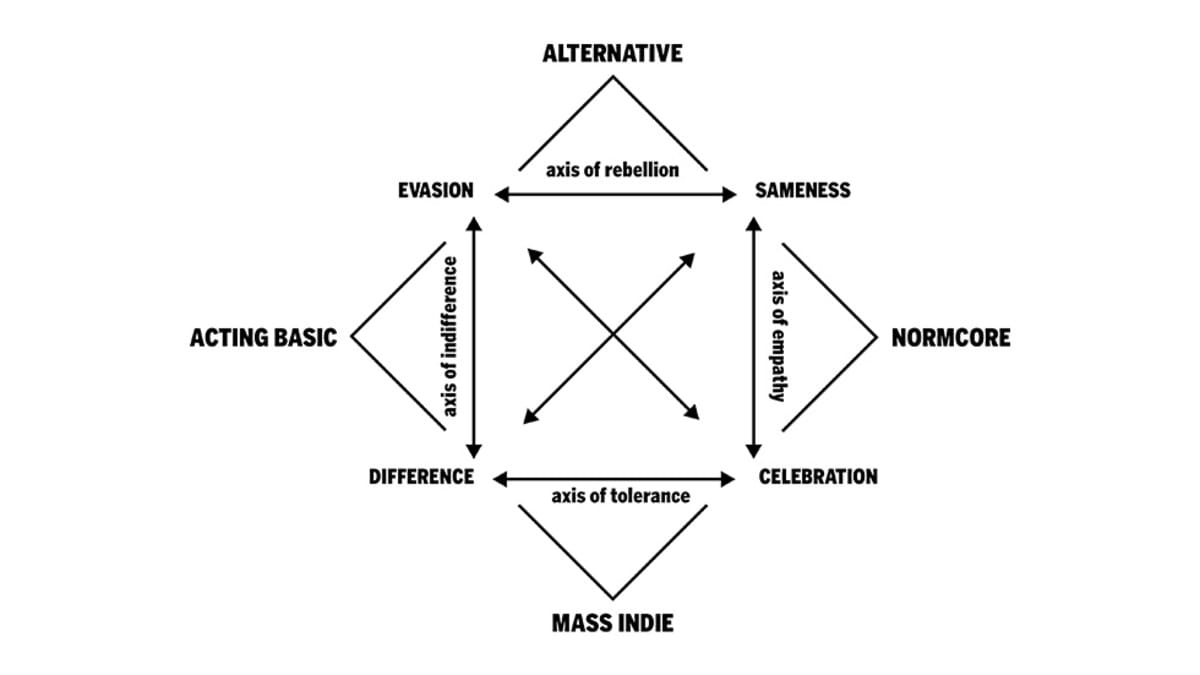
Fredric Jameson mapped White’s fourfold approach using A.J. Greimas’s semiotic square, a graphic tool helpful both for visualizing sets of contrary terms and drawing syntheses between them. For the sake of brevity, I won’t get into the finer details of how the square works, but instead link a to K-Hole’s exemplary use of the tool to map normcore aesthetics. Below is a modified (to include a few additional terms from White’s work that Jameson left out) version of Jameson’s schema:
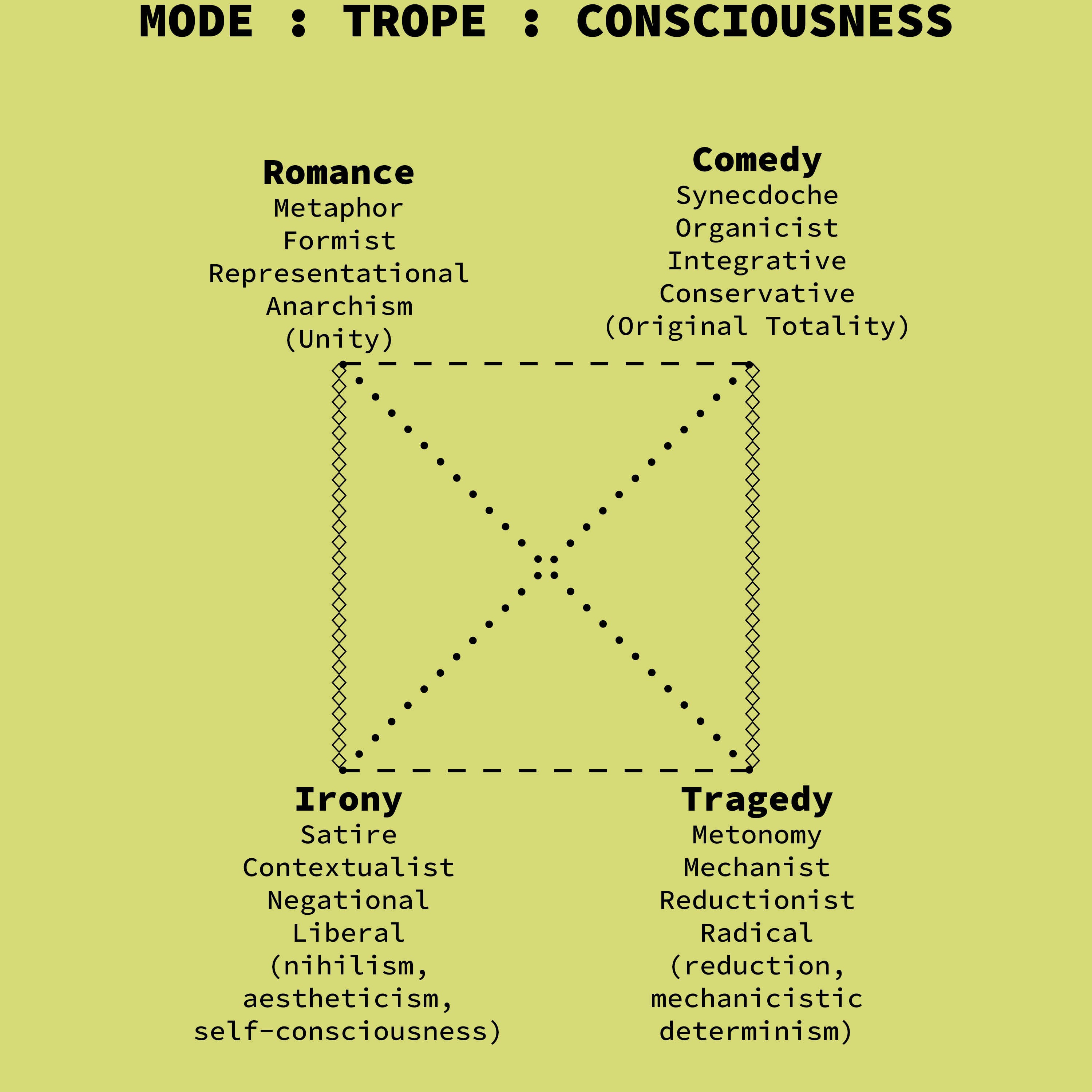
Using Jameson’s arrangement, I’ve pinned four strains of contrary/contradictory utopian impulses to White’s forms. Human utopian impulses tend toward unitary representation and identification. Technological utopian impulses tend toward integrative totality — parts work to serve the whole. Not-human utopian impulses tend toward mechanistic reduction (as exemplified by either robots or Darwinian natural law). Finally, in the lower left square, where Jameson finds “the place of novelty and of paradoxical emergence” sits the negational, ironic turn from progress in the Not-Technological seme. In both Frye and Weisenburger’s approaches to satire, this seme is the seat of the “stale and mouldy,” regressive irony that ineluctably slips into anachronistic ludditism when faced wit the postmodern “'fast-image’ world of adverising, politics, electronic media, and the like." Slaughterhouse-Five falls into this trap.
However, I’ve also used the square to organize syntheses between each pair of contrary terms to point toward hybrid utopias that are more fully realized than those of their simplified counterparts (below):
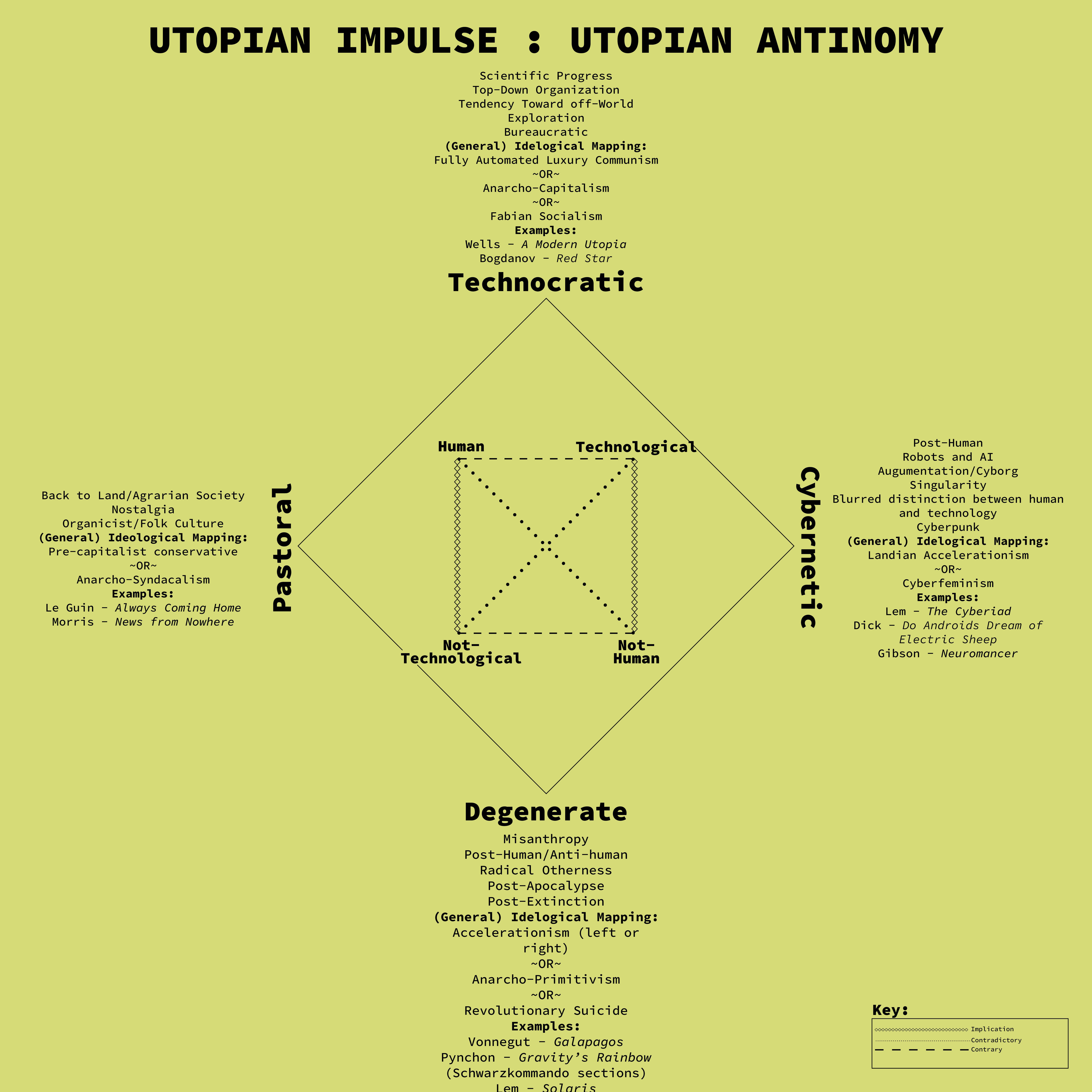
Each of the complex terms carries with it a hybridized version of White’s narrative forms, and in turn, a more complex argumentative structure and ideological orientation. The ideological mappings above are not the only possible results of each synthesis but only a brief sketch of possible results. They’re also not guaranteed to move in the same ideological direction and can, in fact, produce contradictory syntheses that may land far from either of their original two semes (such as a return to a regresive pre-capitalist feudalism in the case of fusing the human and the not-technological).
Vonnegut’s seal-people in Galapagos inhabit a world situated between the not-technological and the not-human (Greimas called this combination of semes the “neutral axis”). Following Weisenberger, I’m calling this the axis of degenerate utopia. In my talk, I’ll be digging into both Vonnegut’s formal blending of tragedy/satire (civilization ends, that’s great!), irony/metonymy (“human” no longer means human…but this took place through evolutionary continuity), negation/reduction (humanity is negated when reduced to pure mechanistic Darwinian natural selection), and finally, liberalism/radicalism (White uses Karl Mannheim’s ideological categories — liberalism seeks gradual improvement and progress, radicalism seeks immediate wholesale change; Vonnegut brings about a revolution through the apocalyptic event in Galapagos that is followed by a billion year period of evolutionary progress as humanity returns to an post-human, post-tech, post-civilizational homeostasis).